There is something fascinating about an old mechanical watch. Perhaps it belonged to a family member, survived decades of everyday use, or was discovered at a flea market for just a few euros. Even when it no longer runs, a vintage watch can have a certain charm that modern timepieces struggle to replicate.
But finding an old watch raises an important question: is it actually worth restoring?
The answer is not always straightforward. Some vintage watches can be brought back to life with a relatively simple service, while others require expensive repairs, rare replacement parts, or extensive restoration work that may exceed their market value.
Whether you are a beginner exploring your first vintage watch or an experienced collector considering another project, understanding what makes a watch worth restoring can save you time, money, and disappointment.
In this guide, we will explore the most important factors to consider before restoring a vintage mechanical watch, from movement condition and originality to spare parts, restoration costs, and sentimental value.
1. Start With the Movement
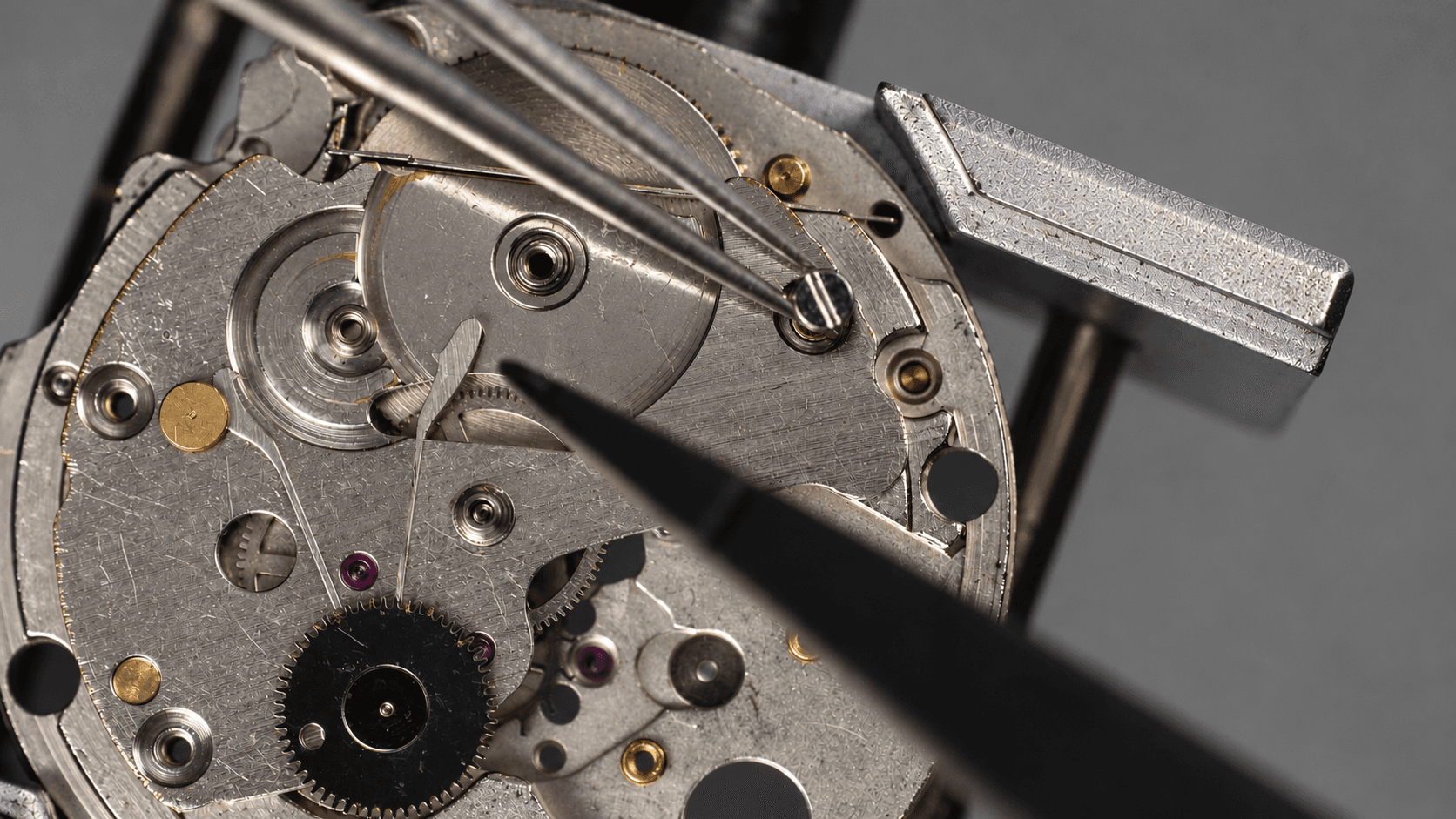
The movement is the mechanical heart of a watch. It contains the gears, springs, escapement, and regulating components responsible for keeping time.
When evaluating a vintage watch, the movement's condition is often more important than its external appearance.
A watch with a heavily scratched case and an aged dial may still contain a perfectly serviceable movement. On the other hand, a beautiful-looking watch can hide serious mechanical problems.
Does the Watch Run?
One of the first things to establish is whether the movement shows any signs of life.
For a manual-winding watch, a watchmaker can carefully assess the winding mechanism and whether the movement responds to stored mainspring power. An automatic watch may require an initial manual wind, if its movement supports it, before its operation can be evaluated.
However, a running watch is not necessarily a healthy watch.
Many vintage movements continue operating despite dried lubricants, worn pivots, or insufficient lubrication. Running these watches for extended periods can accelerate mechanical wear.
Likewise, a watch that does not run is not automatically beyond repair. Sometimes the problem is relatively minor, such as contamination, dried oil, or an issue with the balance assembly.
Important: Avoid repeatedly winding or shaking an unknown vintage watch to force it into operation. A professional inspection is a safer starting point, especially if the watch has not been serviced for decades.
What Should Be Inspected?
A proper movement inspection should consider several important components:
- Balance assembly: The balance wheel, hairspring, pivots, and associated components must be in suitable condition.
- Gear train: The wheels and pinions should rotate freely without excessive wear or damaged teeth.
- Escapement: The pallet fork, escape wheel, and associated jewels must function correctly.
- Mainspring and barrel: The watch needs a reliable source of power to maintain an adequate running reserve.
- Jewels and pivots: Excessive wear or damage can affect efficiency, reliability, and timekeeping.
These components are best evaluated by an experienced watchmaker. Some problems are difficult to identify without removing and examining individual parts under magnification.
2. Originality Can Be More Valuable Than Perfection
One of the biggest mistakes in vintage watch restoration is assuming that every visible sign of age should be removed.
In reality, originality is often one of the most desirable characteristics of a collectible vintage watch.
An original dial with natural aging may be more valuable to collectors than a freshly refinished dial that looks brand new.
The same principle applies to hands, cases, crowns, and other external components.
Original Dials and Patina
Over several decades, watch dials can develop discoloration, spotting, faded printing, and other changes commonly described as patina.
Some collectors appreciate these characteristics because they reflect the watch's history and originality.
However, not all aging is desirable. Severe moisture damage, unstable dial finishes, or extensive corrosion may significantly reduce a watch's appeal and value.
The important distinction is between natural aging that can be preserved and deterioration that threatens the watch's long-term condition.
Before attempting to clean or refinish a vintage dial, consider whether the process could permanently alter its original appearance.
Matching Components Matter
Collectors often pay close attention to whether a watch retains the correct components for its reference and production period.
These may include:
- Original dial and printing
- Period-correct hands
- Correct crown and case components
- Original or appropriate movement caliber
- Correct case back and reference markings
Replacement parts are not necessarily a problem, especially when they are required to restore reliable operation. Nevertheless, incorrect or poorly matched components can affect collectibility.
For historically significant or valuable watches, preserving original parts should be a priority whenever practical.
3. Check for Rust and Water Damage
Moisture is one of the most destructive enemies of a mechanical watch.
When water enters a watch case, it can cause corrosion on steel components, damage delicate pivots, affect the dial, and interfere with the movement's operation.
Unlike ordinary dirt or dried lubricant, serious corrosion can permanently damage mechanical components.
Signs of Water Damage
Several warning signs may indicate that moisture has entered a vintage watch:
- Rust-colored deposits on movement components
- Corrosion around screws and steel bridges
- Discoloration or staining on the dial
- Evidence of moisture beneath the crystal
- Corrosion around the winding stem or case back
Minor surface corrosion does not always mean a watch is beyond repair. However, rust affecting pivots, pinions, the escapement, or the balance assembly can make restoration considerably more complicated.
In severe cases, replacement components may be necessary.
Why Rust Can Become Expensive
Consider two vintage watches with the same movement.
The first has not been serviced for 40 years, but its internal components remain relatively clean and free from corrosion.
The second has suffered water damage, leaving several steel components heavily rusted.
Although both watches may be completely stopped, their restoration requirements can be very different.
The first may require a conventional service and a small number of replacement parts. The second may need extensive mechanical repairs or components that are no longer readily available.
This is why inspecting the movement before committing to a restoration is so important.
4. Spare Parts Availability Can Make or Break a Restoration
A vintage watch can be mechanically repairable in theory but extremely difficult to restore in practice.
One of the biggest challenges is finding suitable replacement parts.
Many vintage movements were discontinued decades ago. Depending on the caliber, original components may be difficult to locate, expensive, or unavailable through conventional suppliers.
Common Movements vs Rare Calibers
Watches containing widely produced movements can sometimes be easier to maintain because more spare parts and donor movements survive.
Certain vintage Seiko, ETA, AS, and other established movement families may offer relatively good parts availability, depending on the exact caliber.
By contrast, obscure movements or unusual complications may require a lengthy search for replacement components.
However, a familiar brand name does not automatically guarantee that parts will be available. Always investigate the specific movement rather than relying on the manufacturer's reputation alone.
What Is a Donor Movement?
A donor movement is another movement, usually of the same caliber or a compatible variation, purchased primarily to supply replacement parts.
For example, if a vintage watch has a damaged balance assembly, a compatible donor movement may provide the components required to complete the repair.
Donor movements can make otherwise difficult restorations possible, but they introduce additional considerations.
The replacement parts must be compatible, and the donor movement itself may contain worn or damaged components.
For rare watches, purchasing an appropriate donor can also become a significant part of the overall restoration cost.
5. Understand the Difference Between Servicing and Restoration
The terms servicing and restoration are sometimes used interchangeably, but they do not necessarily describe the same work.
Mechanical Servicing
A conventional mechanical service generally involves disassembling the movement, cleaning its components, inspecting for wear or damage, replacing necessary parts, applying appropriate lubricants, reassembling the movement, and checking its operation.
The objective is to maintain or restore reliable mechanical function while preserving the watch's character.
For many vintage watches, a careful mechanical service is all that is required.
Full Restoration
A more extensive restoration may involve repairing damaged movement components, replacing missing parts, addressing corrosion, or carrying out carefully considered cosmetic work.
Depending on the watch and the owner's goals, this might include case refinishing, crystal replacement, or other external repairs.
However, extensive cosmetic restoration is not always desirable.
For collectible watches, retaining an original dial, an unpolished case, and historically appropriate components can be more important than achieving a flawless appearance.
The best restoration is not necessarily the one that makes a watch look new. It is the one that preserves as much of the original watch as possible while ensuring appropriate functionality and long-term preservation.
6. Should You Polish a Vintage Watch?
Case polishing is one of the most debated subjects in vintage watch collecting.
While polishing can remove scratches and improve the appearance of a worn case, it also removes a small amount of material from the watch.
Repeated or aggressive polishing can permanently change the shape of a case, soften its edges, and reduce the definition of its original finishing.
Why Collectors Often Prefer Unpolished Cases
Many vintage watches were manufactured with carefully defined case shapes, polished surfaces, brushed finishes, and sharp transitions between different areas.
These details contribute to the original design.
When a case is polished excessively, the original geometry can be lost.
For this reason, collectors often prefer an honest, naturally worn case over one that has been heavily refinished.
Light scratches and signs of normal use are not necessarily defects that need to be removed.
When Is Cosmetic Work Appropriate?
Cosmetic work may be reasonable when the case is severely damaged, when an earlier repair was poorly executed, or when the watch has limited collectible significance and the owner prefers a refreshed appearance.
Even then, the work should be carefully planned.
There is no universal rule that every vintage watch must remain untouched. The right decision depends on the model, its condition, its historical significance, and the owner's priorities.
7. Calculate the Real Cost of Restoration
Before purchasing a non-running vintage watch, it is important to understand that the purchase price is only part of the total investment.
A watch that costs very little initially can become an expensive project if it requires extensive mechanical repairs.
What Affects Restoration Costs?
Several factors influence the final cost:
- The complexity of the movement
- The condition of its internal components
- The availability and price of replacement parts
- The amount of labor required
- Whether specialized repairs are necessary
- The extent of any requested cosmetic work
A relatively common, uncomplicated mechanical movement may be more economical to service than a rare chronograph or an unusual vintage caliber.
However, the condition of the individual watch is often just as important as its complexity.
A Simple Example
Imagine purchasing a vintage watch for €100.
After inspection, you discover that it requires €180 worth of servicing and repairs.
Your total investment would be €280, excluding any additional expenses.
If comparable examples in similar condition typically sell for €200, restoring the watch may not make financial sense if your intention is to resell it.
However, if you genuinely enjoy the watch and intend to keep it, the calculation may be different.
The important thing is to understand the likely costs before making a decision.
These figures are illustrative rather than estimates for a particular watch. Actual service and repair costs vary considerably by movement, condition, location, and watchmaker.
8. Market Value Is Not the Only Kind of Value
Not every watch restoration needs to make financial sense.
Some watches carry personal significance that cannot be measured by their resale value.
A watch inherited from a grandparent, received as a gift, or associated with an important memory may be worth preserving even when the restoration costs exceed its market value.
Financial Value
From a financial perspective, a restoration is easier to justify when the total investment remains reasonable compared with the watch's expected value after repair.
Collectors should consider the watch's originality, condition, rarity, demand, and the prices of genuinely comparable examples.
It is also worth remembering that restoration does not automatically increase a watch's market value.
In some cases, replacing original cosmetic components or refinishing the dial can actually make a collectible watch less desirable.
Sentimental Value
Sentimental value follows a different set of rules.
A relatively inexpensive mechanical watch may represent decades of family history.
Restoring it can allow that history to continue, particularly when the watch can be made reliable without sacrificing its original character.
For many owners, this is the most meaningful reason to restore a vintage timepiece.
9. When Is a Vintage Watch Not Worth Restoring?
Although many vintage watches can be repaired, there are situations where restoration may be impractical or difficult to justify.
Some warning signs include:
- Severe internal corrosion: Extensive rust may affect numerous components and require major repairs.
- Missing critical parts: A rare movement with unavailable components can be extremely challenging to restore.
- Major structural damage: Significant damage to the movement plates, bridges, or case can complicate the project.
- Excessive restoration costs: The required work may substantially exceed the watch's financial value.
- Extensive non-original modifications: Incorrect components may make a collectible watch less desirable.
These are warning signs rather than automatic reasons to abandon a project.
An experienced watchmaker may still be able to repair a movement that initially appears beyond saving.
Nevertheless, recognizing potential problems early helps prevent unrealistic expectations.
10. A Special Warning About Radium Dials
Some older watches, particularly military and civilian models manufactured during parts of the twentieth century, used radium-based luminous paint on their dials and hands.
Radium is radioactive, and deteriorating luminous material can create a contamination hazard if particles become loose or airborne.
Importantly, a dial that no longer glows is not necessarily free from radioactivity.
The presence of radium cannot be reliably established from appearance alone.
If you suspect that a vintage watch contains radium-based luminous material, avoid opening the case, disturbing the dial, scraping the luminous paint, or attempting to clean it yourself.
Seek advice from a suitably qualified professional who can assess the watch and explain the appropriate precautions.
For collectors and hobbyists, understanding this risk is an important part of evaluating older timepieces.
11. A Practical Checklist Before Restoring a Vintage Watch
Before committing to a restoration, consider the following questions:
- Movement: Is the movement complete, and has its mechanical condition been professionally assessed?
- Originality: Does the watch retain its original or period-correct components?
- Corrosion: Are there signs of water damage or serious rust?
- Spare parts: Are suitable replacement components available if required?
- Costs: Have you obtained a realistic estimate for servicing and repairs?
- Collectibility: Could cosmetic restoration negatively affect the watch's originality or value?
- Purpose: Are you restoring the watch to wear, collect, preserve, or resell?
- Safety: Could the watch contain hazardous materials, such as radium-based luminous paint?
Answering these questions will give you a much clearer understanding of whether a particular restoration project makes sense.
12. Final Thoughts: Is Your Vintage Watch Worth Saving?
Determining whether a vintage watch is worth restoring requires more than checking whether it runs or comparing its purchase price with its potential resale value.
The movement's condition, the availability of spare parts, the originality of its components, and the extent of the required work all play an important role.
For collectors, preserving original details is often just as important as restoring mechanical functionality.
For someone who has inherited a family watch, sentimental value may outweigh financial considerations entirely.
Ultimately, every vintage watch has its own story, and every restoration requires an individual approach.
Some watches need little more than a careful mechanical service. Others require extensive repairs, patience, and the search for components that have not been manufactured for decades.
And sometimes, the best decision is to preserve a watch in its current condition rather than pursue an unnecessarily invasive restoration.
A successful vintage watch restoration is not simply about making an old watch run again. It is about understanding what makes that watch worth preserving in the first place.