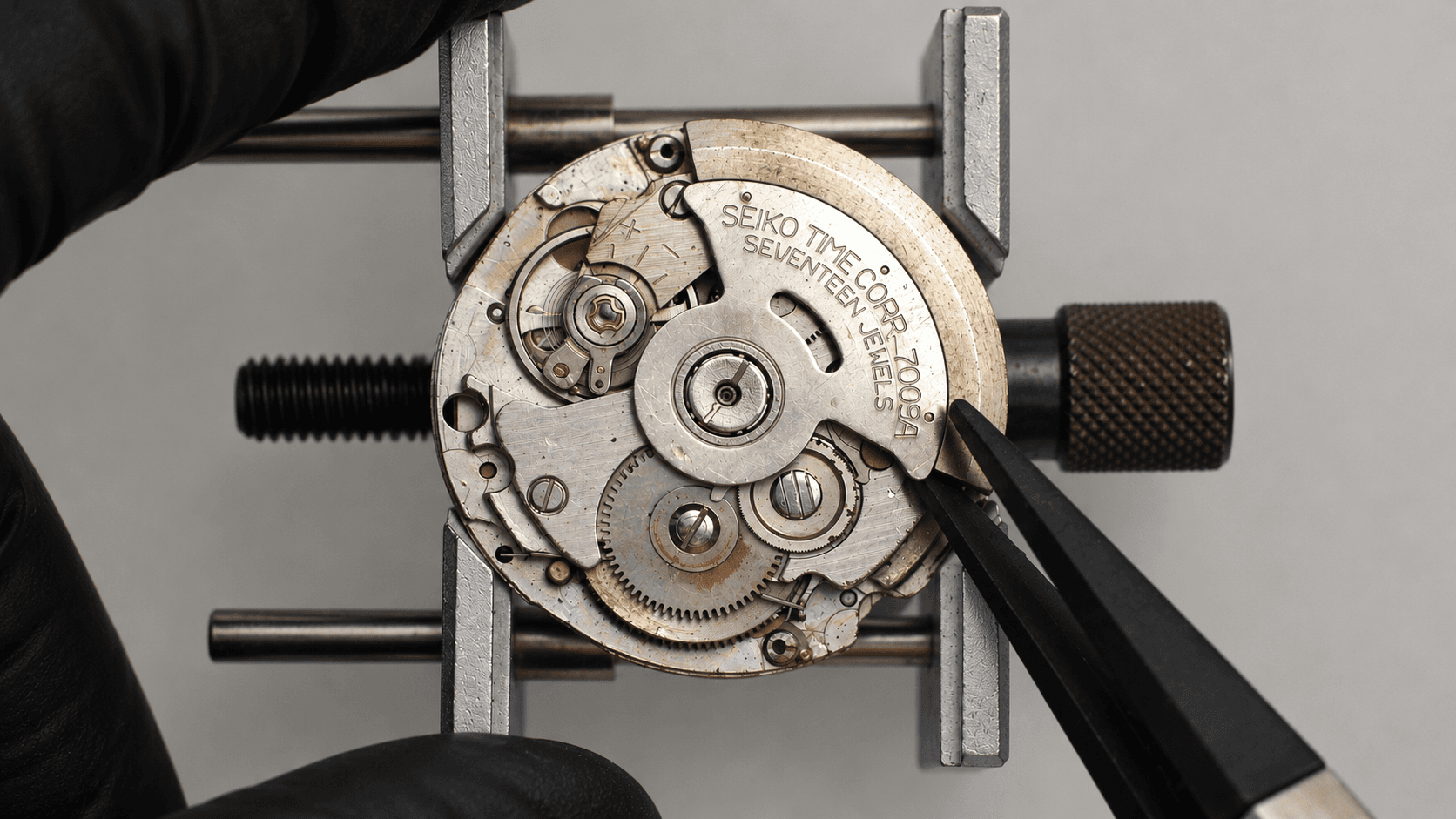
The Seiko 7009 is one of the most recognizable automatic movements found in vintage Seiko watches. Known for its straightforward construction, dependable design, and affordable price, this Japanese calibre powered countless everyday watches during the late twentieth century.
Although it was never intended to compete with luxury Swiss movements, the Seiko 7009 played an important role in making mechanical watchmaking accessible to a wider audience.
Today, decades after its introduction, the movement remains popular among vintage watch collectors, enthusiasts, and hobbyist watchmakers.
But what makes the Seiko 7009 so interesting? How does it work, what are its most common problems, and is it still worth restoring?
In this article, we explore the history, technical specifications, construction, servicing considerations, and lasting legacy of the Seiko 7009 automatic movement.
1. The History of the Seiko 7009
A Mechanical Movement During the Quartz Revolution
The Seiko 7009 was introduced during a period of enormous change in the watch industry.
During the 1970s, quartz technology was rapidly transforming the market. Electronic watches offered excellent accuracy, required less regular maintenance, and became increasingly affordable.
Seiko itself was one of the pioneers of quartz watchmaking, having introduced the world's first commercially available quartz wristwatch, the Seiko Quartz Astron, in 1969.
However, despite the growing popularity of quartz watches, Seiko continued producing mechanical movements.
There was still considerable demand for affordable automatic watches, particularly among customers who appreciated traditional mechanical engineering and the convenience of a self-winding movement.
The Seiko 7009 was developed to serve this market.
Historical movement references generally place its introduction in the mid-to-late 1970s, with production continuing into the 1990s.
This remarkably long production period demonstrates how successfully the movement fulfilled its intended purpose.
The Connection to the Seiko 5
The Seiko 7009 became closely associated with the legendary Seiko 5 collection.
Seiko 5 watches were designed to offer practical features, mechanical reliability, and affordable pricing.
Rather than focusing on elaborate decoration or complicated mechanisms, these watches emphasized functionality and everyday usability.
The 7009 fitted this philosophy perfectly.
Its automatic winding system, day-date complication, and relatively simple construction made it an excellent choice for affordable mechanical wristwatches.
As a result, the movement became particularly common in Seiko 5 models produced throughout the 1980s and early 1990s.
Today, vintage Seiko 5 watches equipped with the 7009 can still be found relatively easily, making them attractive to collectors and watchmaking enthusiasts.
2. Seiko 7009 Technical Specifications
Despite its affordable positioning, the Seiko 7009 is a capable mechanical movement with the essential features expected from a traditional automatic wristwatch.
| Specification | Seiko 7009 |
|---|---|
| Manufacturer | Seiko |
| Calibre | 7009 / 7009A |
| Movement Type | Mechanical Automatic |
| Country of Origin | Japan |
| Production Period | Approximately mid-1970s to mid-1990s |
| Jewels | 17 |
| Frequency | 21,600 vibrations per hour |
| Frequency in Hz | 3 Hz |
| Power Reserve | Approximately 40–43 hours |
| Outside Diameter | 27.4 mm |
| Casing Diameter | 27.0 mm |
| Height | 4.9 mm |
| Functions | Hours, Minutes, Central Seconds, Day and Date |
| Automatic Winding | Yes |
| Manual Winding | No |
| Hacking Seconds | No |
| Shock Protection | Seiko Diashock |
| Lift Angle | 53 degrees |
Understanding the Beat Rate
The Seiko 7009 operates at 21,600 vibrations per hour, equivalent to six beats per second.
This produces the characteristic sweeping movement of a mechanical seconds hand, rather than the once-per-second jump associated with most quartz watches.
A frequency of 21,600 BPH was widely used in mechanical movements during this period.
It provides a practical balance between timekeeping performance, power consumption, and mechanical wear.
What Do 17 Jewels Mean?
The 7009 contains 17 synthetic jewels.
These jewels are used primarily as low-friction bearing surfaces at important points throughout the movement.
They help reduce wear on rotating pivots and other components that experience repeated mechanical contact.
A higher jewel count does not automatically mean a movement is better.
What matters is whether the jewels are used effectively within the movement's design.
For a straightforward automatic movement, the Seiko 7009's 17-jewel construction is entirely appropriate.
3. How the Seiko 7009 Works
Automatic Winding
The Seiko 7009 is a self-winding mechanical movement.
Instead of requiring the owner to wind the watch manually each day, the movement uses energy generated by the motion of the wearer's wrist.
Inside the watch, a semicircular oscillating weight, commonly called the rotor, rotates as the watch moves.
This movement transfers energy through the automatic winding mechanism to the mainspring.
The mainspring stores the energy and gradually releases it through the gear train and escapement.
Seiko's Magic Lever System
One of the most important features of the Seiko 7009 is its automatic winding mechanism.
The movement uses Seiko's well-known Magic Lever system.
This ingenious mechanism allows the movement to use rotor motion in both directions to wind the mainspring.
Compared with some more complicated automatic winding arrangements, the Magic Lever uses a relatively small number of components.
Its simplicity helped make Seiko's automatic movements practical, durable, and economical to manufacture.
The Magic Lever remains one of the most recognizable features of traditional Seiko mechanical engineering.
Why the Seiko 7009 Cannot Be Hand-Wound
Unlike many modern automatic movements, the Seiko 7009 does not support manual winding through the crown.
Turning the crown in its normal position will not wind the mainspring.
Instead, the movement depends on its automatic winding system.
If the watch has stopped, gently moving it can provide enough energy for the movement to begin running.
Once the watch is worn, normal wrist movement continues to wind the mainspring.
This is a normal characteristic of the calibre, not a mechanical defect.
No Hacking Seconds
The Seiko 7009 also lacks a hacking function.
This means the seconds hand continues moving when the crown is pulled out to set the time.
Although hacking is useful when synchronizing a watch precisely, its absence was common among affordable automatic movements of this era.
4. The Seiko 7009 Day-Date Mechanism
One of the most recognizable features of the Seiko 7009 is its day-date complication.
The movement displays both the day of the week and the date through windows on the dial.
However, its calendar-setting mechanism differs from many modern automatic watches.
How to Set the Date
The date is adjusted using the crown's calendar-setting position.
On a properly functioning movement, the date can be advanced without moving the hands through repeated 24-hour cycles.
How to Set the Day
The day of the week is advanced by pressing the crown inward repeatedly.
This push-button-style day correction is a distinctive characteristic of the 7009.
It can surprise collectors who are unfamiliar with vintage Seiko movements.
Important Calendar Precautions
Never force the calendar mechanism.
As with many mechanical watches, the day-date mechanism engages during the hours surrounding midnight.
Using the quickset functions during this period may place unnecessary stress on the calendar components.
As a precaution, move the hands to approximately 6:00 before making quick calendar adjustments.
If the crown or calendar correction feels unusually stiff, stop and investigate the cause.
Resistance may indicate dried lubricant, contamination, worn components, or previous repair damage.
5. Why Was the Seiko 7009 So Popular?
The success of the Seiko 7009 was not based on luxury finishing or complicated engineering.
Its strengths were practical.
Simple and Proven Construction
The movement was designed for dependable everyday operation and efficient manufacturing.
Its relatively straightforward architecture helped keep production costs under control.
Affordable Mechanical Watchmaking
The 7009 allowed customers to enjoy a traditional automatic watch without paying the prices associated with more expensive mechanical timepieces.
This accessibility was one of the defining characteristics of the Seiko 5 collection.
Long Production Life
The movement remained in use for approximately two decades.
Its long production history demonstrates how successfully it fulfilled its intended purpose.
Still Interesting to Collectors
Today, the 7009 is particularly appealing to enthusiasts who appreciate vintage Japanese watchmaking.
Its availability and recognizable construction also make it an interesting movement for hobbyists learning about mechanical watches.
6. Common Problems with the Seiko 7009
After several decades of use, even a well-designed mechanical movement can develop problems.
The condition of an individual Seiko 7009 depends heavily on its service history, environment, and previous repairs.
Here are some of the most common issues worth checking.
1. Dried or Contaminated Lubricants
Mechanical movements depend on carefully selected lubricants to reduce friction and wear.
Over time, these lubricants can deteriorate, migrate, or become contaminated with dust and debris.
This increases friction between moving components and can negatively affect performance.
Possible symptoms include:
- Reduced balance amplitude
- Poor timekeeping
- Shortened power reserve
- Intermittent stopping
- Difficulty starting the movement
A movement that runs is not necessarily a movement that is properly serviced.
Continuing to operate a watch with inadequate lubrication can accelerate mechanical wear.
2. Automatic Winding Problems
If a Seiko 7009 stops frequently despite being worn, its automatic winding system deserves attention.
Possible causes include contamination, worn components, or problems within the rotor and winding mechanism.
The mainspring and barrel should also be considered.
A watch that runs briefly after being moved but cannot maintain adequate power may have a winding or power-storage problem.
3. Calendar Malfunctions
The day-date mechanism contains several small components that must interact correctly.
Over time, these parts may become worn, damaged, or contaminated with old lubricant.
Common symptoms include:
- Incomplete calendar changes
- The day or date failing to advance
- A stiff calendar correction mechanism
- The calendar becoming stuck between positions
Forcing the mechanism can make an existing problem worse.
4. Low Balance Amplitude
Low amplitude is a common concern when examining vintage mechanical movements.
It can result from excessive friction, insufficient mainspring power, escapement problems, or contamination.
A timegrapher is useful for measuring the movement's performance.
For the Seiko 7009, the commonly documented lift angle is 53 degrees.
Using the correct lift-angle setting is important when interpreting amplitude readings.
However, a single timegrapher reading cannot establish the condition of the entire movement.
5. Previous Repair Damage
Not every problem is caused by age.
Vintage watches may have been opened and repaired several times during their lives.
Damaged screw heads, bent components, incorrect lubrication, and improperly fitted replacement parts can all create additional problems.
Careful inspection is therefore an essential part of any restoration.
7. Restoring a Seiko 7009 Movement
Restoring a vintage mechanical movement involves much more than simply making it run.
A proper service includes evaluating the movement, identifying worn or damaged components, cleaning suitable parts, applying the correct lubricants, and testing performance after reassembly.
The following overview describes the general restoration process rather than a complete step-by-step service manual.
Step 1: Initial Inspection
Before disassembly, examine the overall condition of the watch.
Check whether the movement runs, whether the hands can be adjusted, and whether the calendar operates correctly.
If possible, record its performance using a timegrapher.
Inspect the movement for corrosion, missing components, previous repair damage, and obvious mechanical faults.
Taking photographs during disassembly can also be extremely useful during reassembly.
Step 2: Careful Disassembly
Remove the movement from its case using appropriate watchmaking tools.
The hands and dial must be removed carefully to avoid scratching or bending them.
Once the movement is accessible, its components can be dismantled in a controlled sequence.
Special attention should be given to delicate parts such as the balance assembly, hairspring, pallet fork, and calendar components.
Never apply unnecessary force.
Step 3: Cleaning the Movement
Cleaning is one of the most important parts of a mechanical watch service.
Old lubricants, dust, and contamination must be removed from suitable components before reassembly.
Professional watchmakers use specialized cleaning methods and solutions.
Ultrasonic cleaning can be useful for appropriate disassembled metal parts, but it is not suitable for every component.
Delicate assemblies such as the balance and hairspring, as well as the pallet fork, require special handling and should not simply be placed into a general-purpose ultrasonic cleaner.
Cleaning methods must also account for components containing plastics, adhesives, coatings, or other sensitive materials.
A movement should never be cleaned indiscriminately as a complete assembled unit.
Step 4: Inspection After Cleaning
Once the parts are clean and dry, inspect them for wear and damage.
Pay particular attention to:
- Wheel pivots
- Jewel bearings
- Gear teeth
- The mainspring barrel
- The escapement
- The automatic winding mechanism
Cleaning cannot repair a worn pivot or damaged wheel.
Any defective component must be evaluated and replaced where necessary.
Step 5: Reassembly and Lubrication
During reassembly, correct lubrication is essential.
Different parts of a mechanical movement require different lubricants and application methods.
Using too much oil can be just as problematic as using too little.
Excess lubricant can spread to areas where it does not belong, while insufficient lubrication increases friction and wear.
Always follow appropriate technical documentation and lubrication guidance for the movement.
Step 6: Testing and Regulation
After reassembly, the movement should be tested carefully.
Important measurements and checks include:
- Daily rate
- Balance amplitude
- Beat error
- Performance in different positions
- Power reserve
- Automatic winding operation
- Day-date functionality
Regulation should only be attempted after confirming that the movement is mechanically healthy.
Adjusting the regulator cannot compensate for every underlying mechanical fault.
8. Is the Seiko 7009 a Good Movement for Beginners?
The Seiko 7009 can be a rewarding movement to study, especially for enthusiasts interested in vintage Japanese watchmaking.
Its construction is relatively straightforward, and technical documentation is available.
However, beginners should approach it with realistic expectations.
The automatic winding and calendar mechanisms add complexity compared with a basic hand-wound movement.
The balance assembly and escapement also require careful handling.
For someone learning watchmaking, it is often sensible to begin with an inexpensive practice movement before working on a complete vintage watch in good condition.
A working original Seiko 7009 deserves the same care as a more expensive movement.
Its monetary value may be modest, but its historical and mechanical value is still worth preserving.
9. Seiko 7009 vs. Seiko 7S26
The Seiko 7009 is often compared with the later Seiko 7S26.
Both movements are associated with affordable Seiko automatic watches, and they share a similar design philosophy.
| Feature | Seiko 7009 | Seiko 7S26 |
|---|---|---|
| Movement Type | Automatic | Automatic |
| Jewels | 17 | 21 |
| Frequency | 21,600 BPH | 21,600 BPH |
| Day-Date | Yes | Yes |
| Manual Winding | No | No |
| Hacking Seconds | No | No |
| Main Association | Vintage Seiko 5 | Later-generation Seiko 5 |
The 7S26 became one of Seiko's best-known later-generation entry-level automatic movements.
Although it introduced changes to the construction, it continued the same general philosophy: practical mechanical timekeeping at an affordable price.
The 7009 represents an earlier chapter in that story.
For collectors, this historical connection makes both movements interesting.
10. Is a Vintage Seiko 7009 Worth Restoring?
Whether a Seiko 7009 is worth restoring depends on several factors.
From a purely financial perspective, professional servicing can sometimes cost more than the market value of the watch.
However, restoration is not always about resale value.
A vintage watch may have sentimental importance, an attractive original dial, or historical interest.
For hobbyist watchmakers, restoring a movement can also provide valuable practical experience.
The 7009 is especially appealing because it represents an era when Seiko continued producing affordable mechanical watches despite the rapid expansion of quartz technology.
When properly serviced and maintained, a healthy example can remain an enjoyable mechanical watch.
The key is to evaluate its condition realistically and avoid replacing original components unnecessarily.
11. The Legacy of the Seiko 7009
The Seiko 7009 was never designed to be a prestigious movement.
It did not feature elaborate decoration, expensive finishing, or unusual complications.
Instead, it delivered what many people actually needed: an accessible, practical, automatic watch movement.
That simplicity is precisely what makes it interesting today.
Decades after its introduction, the 7009 continues to appear in vintage Seiko watches around the world.
Some examples are still running despite having received little recent maintenance. Others require careful restoration after years of neglect.
Each surviving movement represents a small part of Seiko's mechanical watchmaking history.
For collectors, the 7009 offers an affordable entry into vintage Seiko ownership.
For hobbyist watchmakers, it provides an opportunity to explore the construction and servicing of a classic Japanese automatic movement.
And for anyone who appreciates traditional watchmaking, it is a reminder that an important movement does not necessarily have to be expensive.
Sometimes, the most interesting watches are the ones that were built simply to be worn.
Final Thoughts
The Seiko 7009 deserves recognition as one of the familiar workhorse movements of vintage Japanese watchmaking.
Its combination of automatic winding, day-date functionality, straightforward construction, and long production history helped make mechanical watches accessible to a wide audience.
Today, it remains a worthwhile subject for restoration and mechanical study.
At Timeless Tickers, we believe that even affordable vintage movements deserve proper care and attention.
Because behind every mechanical watch, regardless of its price, there is a piece of watchmaking history worth preserving.
References & Further Reading
The technical specifications and historical information in this article were checked against the following movement references:
- Mizeni – Seiko 7009 Movement Details
- Watch Movements Archive – Seiko 7009A
- Caliber Corner – Seiko Caliber 7009
- The Movement Archive – Seiko 7009A
Technical specifications may vary slightly between references. The restoration information above is intended as a general overview and does not replace the manufacturer's service documentation.