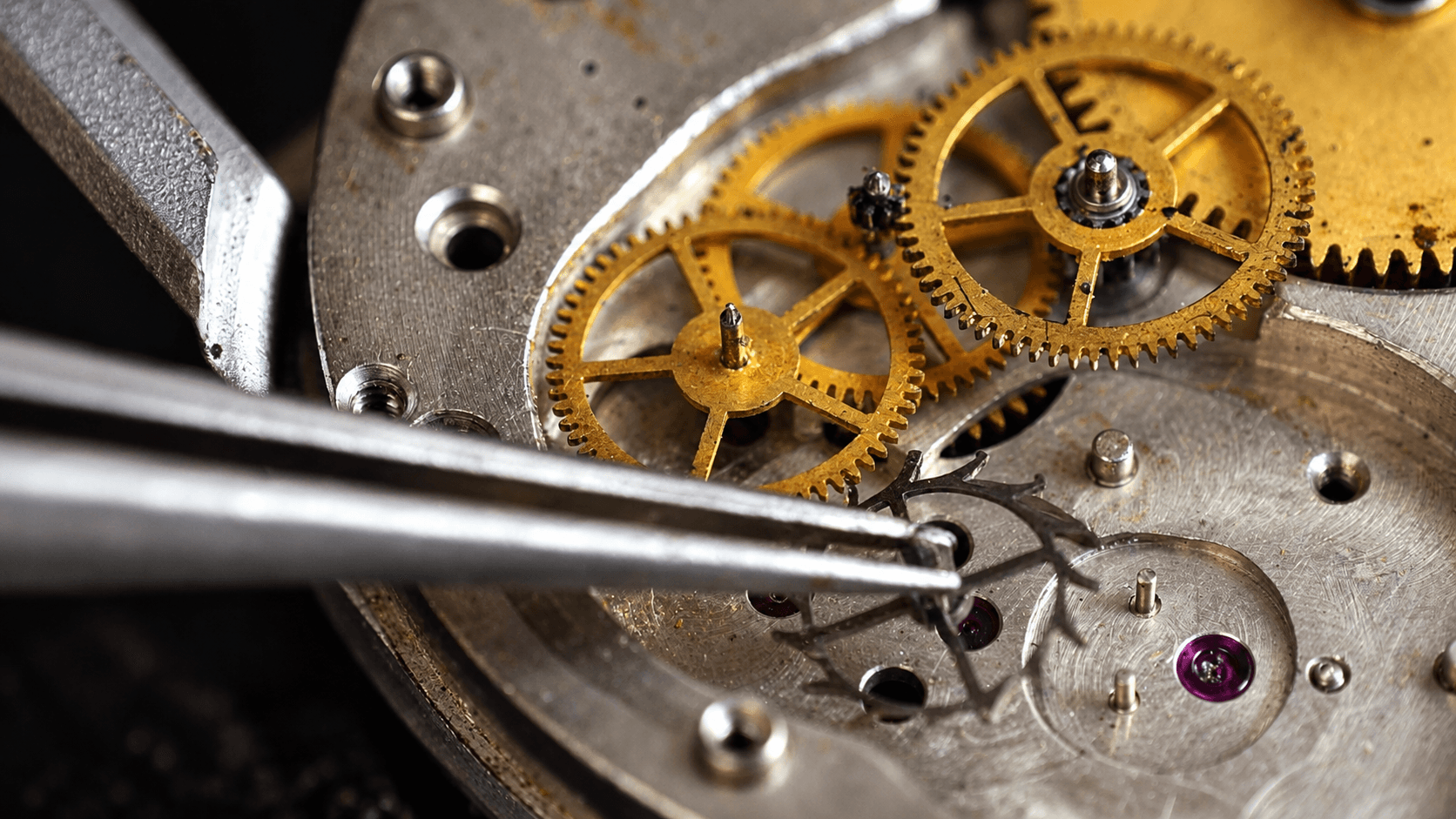
There is something fascinating about a mechanical watch that has survived for decades. Inside its small metal case, hundreds of carefully manufactured components work together to measure the passage of time without electronics or batteries.
Yet even the finest vintage watches can eventually stop working.
Perhaps you inherited an old Omega that has been sitting in a drawer for thirty years. Maybe you purchased a beautiful vintage timepiece that runs for a few minutes before stopping. Or perhaps your mechanical watch suddenly stopped after years of reliable operation.
The good news is that a stopped vintage watch is not necessarily a broken watch. Many mechanical problems can be corrected through professional servicing, cleaning, lubrication, or the replacement of damaged components.
In this guide, we explore eight common reasons why vintage mechanical watches stop working, explain what happens inside the movement, and discuss whether these problems can be repaired.
1. Dried or Deteriorated Lubricants
One of the most common problems encountered when restoring vintage mechanical watches is deteriorated lubrication.
A mechanical watch contains numerous moving components, including gears, pivots, bearings, and the escapement. These parts require carefully selected lubricants to minimize friction and prevent unnecessary wear.
When a watch is properly serviced, extremely small quantities of specialized watch oils and greases are applied to specific locations throughout the movement.
However, these lubricants do not last forever.
Over many years, watch oils can deteriorate, migrate away from their intended locations, or become contaminated with dirt and microscopic particles. Older lubricants may also thicken or leave deposits behind.
As lubrication deteriorates, friction increases throughout the movement.
This creates several possible symptoms:
- The watch begins losing time.
- The balance wheel oscillates with reduced amplitude.
- The watch stops intermittently.
- The movement runs in certain positions but stops in others.
- The watch eventually stops completely.
In severe cases, continued operation without adequate lubrication can damage delicate wheel pivots and their bearings.
Can Dried Watch Oil Be Fixed?
Yes. If the movement has not suffered significant mechanical damage, a complete service can often restore reliable operation.
During servicing, the watchmaker disassembles the movement, cleans its components, inspects them for wear, and applies fresh lubricants during reassembly.
Important: Simply adding fresh oil to a dirty movement is not a substitute for proper servicing. Old lubricant deposits and contamination must be removed before the movement is correctly lubricated.
2. A Broken or Weakened Mainspring
The mainspring is the primary source of energy in a traditional mechanical watch.
Located inside a cylindrical component called the mainspring barrel, this long, thin strip of metal stores energy when the watch is wound.
As the mainspring gradually unwinds, it releases energy through the gear train, allowing the escapement and balance wheel to regulate the movement.
Without sufficient energy from the mainspring, the watch cannot continue running.
In vintage watches, mainspring problems are relatively common, particularly in movements that have experienced decades of use.
Possible problems include:
- A broken mainspring.
- A weakened mainspring that delivers insufficient torque.
- A damaged mainspring attachment.
- Excessive friction inside the mainspring barrel.
- Problems with the winding mechanism.
A broken mainspring may prevent the watch from storing energy, even when the crown is turned.
However, a watch that stops shortly after winding does not automatically have a broken mainspring. Excessive friction elsewhere in the movement can produce similar symptoms.
Can a Broken Mainspring Be Replaced?
In many cases, yes.
Mainspring replacement is a relatively common procedure during mechanical watch restoration.
When the correct replacement is available, a watchmaker can install a suitable mainspring and inspect the barrel assembly for additional problems.
For particularly rare vintage movements, finding a compatible replacement may require additional research or sourcing from donor movements.
3. Dirt, Dust, and Contamination Inside the Movement
Mechanical watch movements are precision mechanisms designed to operate with extremely small tolerances.
Even tiny particles of dirt can interfere with their operation.
Over time, contamination can enter a vintage watch through deteriorated case seals, damaged crystals, or poorly fitted casebacks.
Particles may also accumulate inside the movement as lubricants age and mechanical components wear.
When contamination reaches important moving parts, it can increase friction or interfere with their movement.
Particularly sensitive areas include:
- Wheel pivots and jewel bearings.
- The escapement mechanism.
- The balance assembly.
- The winding and setting mechanism.
In some cases, a watch may continue operating despite contamination, but its performance gradually deteriorates.
Eventually, the movement may no longer have enough available energy to overcome the increased resistance.
How Is a Dirty Watch Movement Cleaned?
Professional cleaning involves much more than wiping visible surfaces.
The movement must be carefully disassembled so that its components can be inspected and cleaned using appropriate watchmaking equipment and cleaning solutions.
After cleaning, the parts are examined for damage before the movement is reassembled and lubricated.
Cleaning can restore the operation of a contaminated movement, provided that the underlying components remain in suitable condition.
4. A Damaged Balance Staff or Balance Assembly
The balance wheel is one of the most recognizable components inside a mechanical watch.
Working together with the hairspring, it forms the oscillating system that controls the rate at which the escapement releases energy.
The balance wheel rotates back and forth around a delicate axle known as the balance staff.
In older watches, particularly those without modern shock-protection systems, the balance staff can be vulnerable to damage from impacts.
Dropping a vintage watch onto a hard surface may damage or break one of the extremely fine pivots at the ends of the balance staff.
When this happens, the balance wheel may no longer oscillate correctly.
Common symptoms include:
- The watch stops immediately after being dropped.
- The balance wheel does not move freely.
- The movement runs briefly in one position but stops in another.
- The watch cannot maintain a stable rate.
Not every balance-related problem involves a broken staff. Damaged jewels, hairspring distortion, or interference between components can also prevent normal oscillation.
Is a Broken Balance Staff Repairable?
Yes, although the difficulty depends on the movement.
Some vintage calibers have replacement balance staffs available, while others require rare original components or donor parts.
Replacing a balance staff is a delicate watchmaking operation that requires specialized tools, careful assembly, and accurate adjustment.
5. Magnetization of the Hairspring
Magnetism is another factor that can affect the performance of mechanical watches.
Many vintage movements contain components made from materials that are susceptible to magnetic fields.
The hairspring is particularly important because it controls the oscillation of the balance wheel.
When susceptible hairspring coils become magnetized, they may attract one another and interfere with the spring's normal movement.
This changes the effective behavior of the hairspring and can cause significant timekeeping errors.
A magnetized mechanical watch may:
- Run unusually fast.
- Show unstable timekeeping.
- Lose time in certain circumstances.
- Experience severe balance oscillation problems.
Although magnetization is often associated with watches running fast, severe magnetic interference can sometimes contribute to a watch stopping.
Common sources of magnetic fields include speakers, magnetic clasps, electronic devices, and other objects containing strong magnets.
Can a Magnetized Vintage Watch Be Fixed?
Fortunately, demagnetization is generally a straightforward procedure when magnetism is the underlying problem.
A watchmaker can use a suitable demagnetizing device to remove residual magnetism from susceptible movement components.
However, demagnetization will not correct mechanical damage, deteriorated lubrication, or an incorrectly adjusted hairspring.
6. Rust and Moisture Damage
Water is one of the greatest enemies of vintage mechanical watches.
Although some older watches were originally advertised as water-resistant, their original level of protection should never be assumed to remain effective decades later.
Case gaskets deteriorate, crystals may develop cracks, and corrosion can compromise the integrity of the case.
Even small amounts of moisture entering the movement can cause serious problems.
Rust may develop on steel components such as:
- Wheel pivots.
- Screws and springs.
- The winding stem.
- Parts of the escapement.
- The balance staff.
- Other steel movement components.
As corrosion progresses, delicate components may become damaged or completely immobilized.
In severe cases, rust can also affect the movement plates and the surrounding areas of jewel bearings.
Can a Rusty Vintage Watch Be Restored?
It depends on the extent of the damage.
Light surface corrosion may sometimes be treated successfully during restoration.
However, heavily corroded pivots, springs, and other precision components often require replacement rather than simple cleaning.
Some watches with extensive water damage can still be restored, but the process may become expensive and technically challenging.
Important: If you notice condensation or moisture beneath the crystal, avoid winding or operating the watch and arrange professional inspection as soon as possible. Continued operation can worsen the damage.
7. Worn Gears, Pivots, and Jewel Bearings
Mechanical watches are designed for longevity, but their components are not immune to wear.
Inside the movement, energy travels from the mainspring barrel through a series of gears commonly referred to as the gear train.
Each wheel rotates on carefully manufactured pivots supported by bearings, many of which contain synthetic or natural jewels.
These jewels provide hard, low-friction bearing surfaces that help reduce wear.
However, if lubrication becomes inadequate or contamination enters the movement, friction can gradually damage the contact surfaces.
Over many years, this may lead to:
- Worn or scored wheel pivots.
- Damaged jewel bearings.
- Excessive play in moving components.
- Increased friction throughout the gear train.
- Reduced efficiency and balance amplitude.
These problems can become especially noticeable in watches that have operated for long periods without maintenance.
Can Worn Watch Components Be Repaired?
Many worn components can be replaced, repaired, or restored using specialized watchmaking techniques.
However, the availability of suitable replacement parts plays an important role.
For common vintage Swiss movements, replacement wheels and other components may still be available through specialist suppliers or donor movements.
Rare calibers can present greater challenges, particularly when replacement parts must be manufactured or adapted.
8. Problems With the Escapement
The escapement is one of the most important mechanisms inside a mechanical watch.
It controls the release of energy from the gear train and transfers impulses to the balance wheel, allowing the watch to maintain regular oscillations.
In a typical Swiss lever escapement, important components include the escape wheel, pallet fork, pallet stones, and balance roller assembly.
These parts must interact with exceptional precision.
Even relatively small mechanical problems can interfere with the escapement's operation.
Potential issues include:
- Damaged escape wheel teeth.
- Incorrectly positioned or damaged pallet stones.
- Contaminated or improperly lubricated escapement surfaces.
- Damaged pallet fork pivots.
- Incorrect interaction between the pallet fork and balance roller.
When the escapement cannot transfer energy correctly, the balance wheel may lose amplitude and eventually stop.
Can Escapement Problems Be Repaired?
In many cases, yes.
However, proper diagnosis requires an understanding of escapement geometry and the interaction between the movement's components.
Depending on the problem, restoration may involve cleaning, adjustment, lubrication, or replacement of damaged parts.
Why Does My Vintage Watch Start and Then Stop?
A particularly common problem with vintage mechanical watches is a movement that starts running but stops again after a few seconds or minutes.
This behavior can be frustrating because the watch initially appears to be functioning.
Several mechanical conditions can produce this symptom.
One possibility is excessive friction caused by deteriorated lubrication or contamination.
Another is insufficient energy reaching the escapement due to a weakened mainspring or problems within the gear train.
Balance-related problems can also cause intermittent operation, particularly when the movement is affected by positional changes.
For example, a watch might run while lying flat on a table but stop when placed vertically.
This can indicate problems involving balance pivots, bearings, endshake, or other movement components.
However, the exact cause cannot be reliably determined from the symptom alone. A proper inspection is necessary to identify the underlying mechanical problem.
Can a Vintage Watch Stop Working After Years in Storage?
Absolutely.
It is common to encounter vintage watches that have remained unused for twenty, thirty, or even fifty years.
Some of these watches may still begin ticking when wound, while others remain completely stationary.
Long-term storage does not automatically mean that the movement is damaged.
However, the passage of time can affect the condition of lubricants, seals, and certain mechanical components.
Even if a vintage watch begins running after decades in storage, this does not necessarily mean it is ready for regular use.
Operating a movement with deteriorated lubrication can accelerate wear on delicate components.
For valuable or historically significant watches with an unknown service history, professional inspection is advisable before regular operation.
What Should You Do If Your Vintage Watch Stops Working?
If your vintage mechanical watch has stopped, there are several sensible steps you can take before arranging a professional inspection.
Step 1: Check Whether the Watch Needs Winding
A mechanical watch cannot run without stored energy.
If the watch is hand-wound, it may simply have exhausted its power reserve.
For a watch known to be in good condition, gently winding the crown may be enough to restart the movement.
Never force the crown if you encounter unusual resistance or suspect mechanical damage.
Step 2: Observe the Watch's Behavior
If the watch starts running, pay attention to how it behaves.
Does it stop after a few seconds? Does it run for several hours? Does it stop when its position changes?
These observations can provide useful information during professional diagnosis.
Step 3: Look for Signs of Damage
Check for visible problems such as a cracked crystal, condensation beneath the glass, or signs of previous impact.
Visible moisture should be treated as a reason to seek prompt professional attention.
Step 4: Avoid Unnecessary Experimentation
Do not repeatedly shake, strike, or force a stopped vintage watch in an attempt to make it run.
Likewise, avoid opening the movement or applying household lubricants unless you have the appropriate watchmaking knowledge and equipment.
Improper handling can turn a relatively simple repair into a much more complicated restoration.
Step 5: Consider Professional Servicing
If the watch continues to stop or has an unknown maintenance history, a qualified watchmaker can inspect the movement and determine whether servicing or component replacement is necessary.
Is a Vintage Watch Worth Repairing?
Not every vintage watch has significant monetary value, but financial value is only one factor when considering restoration.
Some watches are valuable because of their manufacturer, rarity, movement, or historical significance.
Others may have relatively modest market values but considerable sentimental importance.
Before deciding whether to restore a watch, consider the following:
- Movement condition: Is the mechanism complete, or are important components missing?
- Availability of parts: Can suitable replacement components be sourced?
- Historical significance: Does the watch have unusual features or collectible importance?
- Originality: Can the watch be restored without unnecessarily altering its original character?
- Restoration cost: Is the required work reasonable compared with the watch's value and personal importance?
In many cases, an apparently lifeless vintage watch can be brought back into reliable working condition.
However, some restorations require extensive work, and others may not be economically practical.
The decision ultimately depends on the individual watch and the owner's priorities.
How Can You Prevent a Vintage Watch From Stopping?
Although mechanical wear cannot be eliminated completely, proper care can significantly improve the long-term reliability of a vintage timepiece.
Several simple habits can help preserve its condition:
- Arrange periodic professional servicing appropriate to the movement and its usage.
- Avoid exposing the watch to unnecessary moisture.
- Protect the movement from strong impacts and vibrations.
- Keep the watch away from strong magnetic fields.
- Never force the winding or setting mechanism.
- Store the watch in a clean, dry environment.
- Have unusual timekeeping behavior investigated before further damage develops.
Service intervals vary depending on the movement, its condition, and how frequently it is worn.
For vintage watches, an experienced watchmaker can recommend an appropriate maintenance schedule after inspecting the movement.
Frequently Asked Questions
Can a vintage mechanical watch last forever?
A well-maintained mechanical watch can operate for generations. However, its components are subject to wear, and continued operation depends on maintenance, repair, and the availability of replacement parts.
Why does my vintage watch stop overnight?
The watch may have an insufficient power reserve, a worn mainspring, or excessive friction within the movement. Automatic watches may also stop if they have not received enough winding energy during wear.
Can a mechanical watch stop because of old oil?
Yes. Deteriorated or contaminated lubricants can increase friction and reduce the energy available to the escapement. In severe cases, this can cause the movement to stop completely.
Is it normal for an old watch to stop occasionally?
A mechanical watch will naturally stop when its power reserve is exhausted. However, repeated stopping despite adequate winding can indicate a mechanical problem that requires inspection.
Can you fix a vintage watch that has not worked for decades?
Many vintage watches can be restored after decades of inactivity. The outcome depends on the movement's condition, the extent of any damage, and whether suitable replacement parts are available.
Should I wind a vintage watch that has been sitting for 30 years?
If the watch has an unknown service history, professional inspection is the safest approach before regular operation. Old lubricants may have deteriorated, and running the movement could cause unnecessary wear.
Final Thoughts
A vintage watch that has stopped working is not necessarily beyond repair.
From dried lubricants and weakened mainsprings to damaged balance staffs and worn escapement components, there are many reasons why a mechanical movement may stop operating.
Fortunately, many of these problems can be corrected through careful diagnosis and professional restoration.
Every vintage watch has its own mechanical history. Some require only routine maintenance, while others need extensive repairs and the replacement of damaged components.
Understanding these differences is an important part of appreciating traditional watchmaking.
At Timeless Tickers, we explore the craftsmanship, engineering, and restoration techniques that keep vintage mechanical watches alive.
Because sometimes, a watch that has been silent for decades is simply waiting for the right hands to bring it back to life.